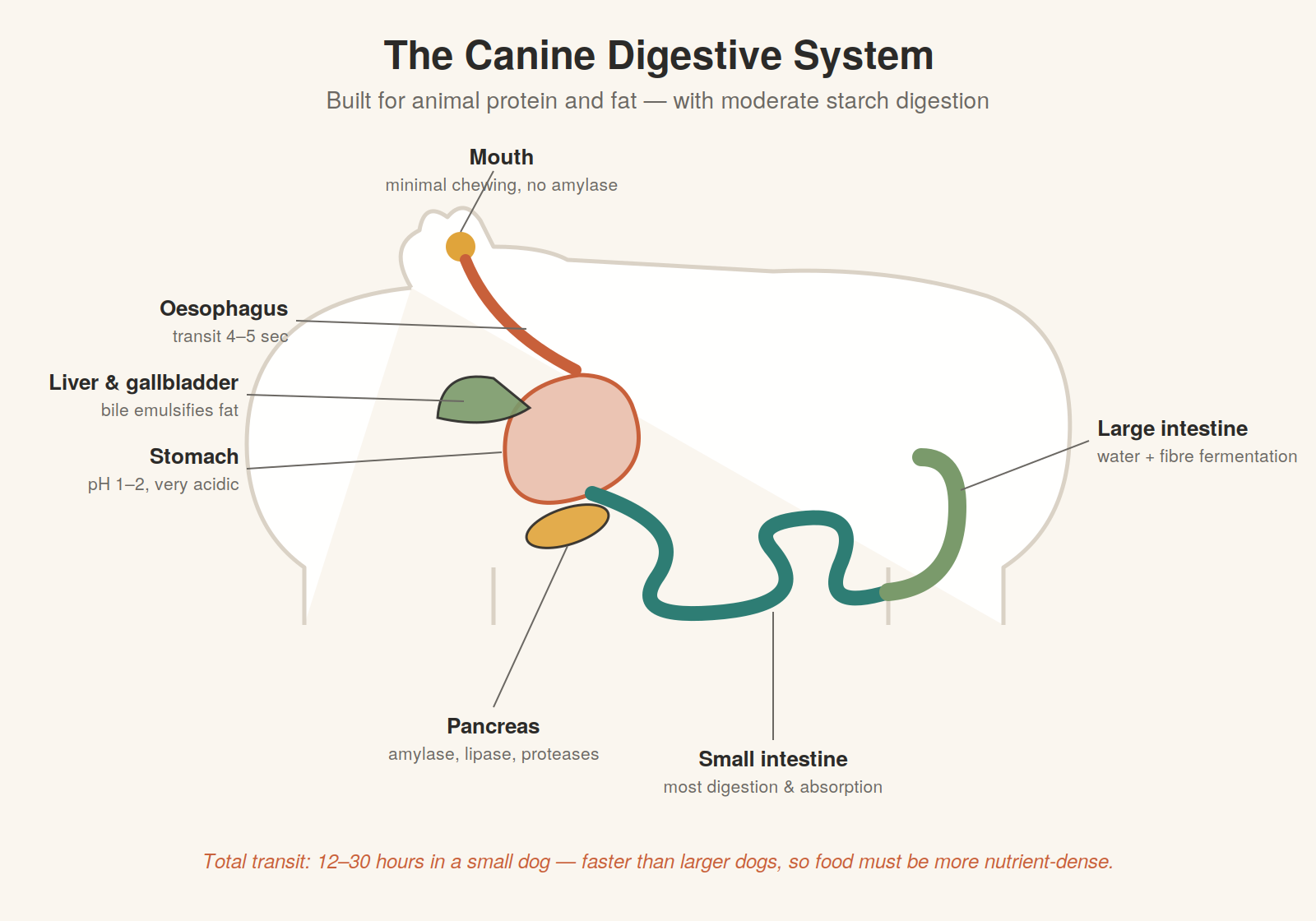
Learning objectives: Trace the path food takes through a dog’s digestive system; identify what digestion happens at each stage; explain why dogs are facultative carnivores.
Carnivore? Omnivore? Both?
There’s a long-running argument about whether dogs are carnivores or omnivores. The honest answer: dogs are facultative carnivores. Their anatomy is optimised for animal protein and fat — short gut, acidic stomach, minimal carbohydrate-digesting enzymes in saliva — but over 15,000 years alongside humans they’ve evolved to digest moderate amounts of starch.
Genetic studies confirm this: domesticated dogs carry more copies of the amylase gene (AMY2B) than wolves, so they break down starch more efficiently than their ancestors. They’re not obligate carnivores like cats, but they’re not omnivores like pigs either. The closest analogy is a brown bear — primarily carnivorous, opportunistically omnivorous. This tells you the proportions to aim for: protein-heavy, fat-rich, with carbohydrates in a supporting role.
The journey of a meal
- Mouth. Dogs barely chew. Saliva contains essentially no amylase, so no carbohydrate breakdown starts here — the mouth’s job is mechanical.
- Oesophagus. A simple muscular tube; food transits in 4–5 seconds.
- Stomach. Highly acidic — pH 1–2 when full, several times more acidic than a human stomach. This lets dogs digest raw bone (with caveats), tolerate bacterial loads that would hospitalise a human, and begin protein digestion via pepsin. Emptying takes 4–8 hours.
- Small intestine. Where most digestion and absorption happen. Pancreatic enzymes and bile enter here. Proportionally shorter than herbivores’, longer than cats’.
- Pancreas. Produces amylase (starch), lipase (fat), proteases (protein) and bicarbonate (neutralises stomach acid). Its failure mode — pancreatitis — is a common small-dog emergency.
- Liver and gallbladder. Produce and concentrate bile, which emulsifies fat so lipase can work.
- Large intestine. Water reabsorption and fibre fermentation by gut bacteria. A healthy microbiome here matters for stool quality and immune function.
Total transit time: 12–30 hours for a small dog, 24–48 for a medium dog. Faster transit means less time to extract nutrients — another reason small dogs need concentrated nutrition per gram.
What this means for feeding
- Animal protein is preferentially digested — more usable amino acids per gram from chicken than soy.
- Fat is efficiently absorbed — up to 95% of dietary fat.
- Whole grains need cooking — raw starches pass through largely undigested (why kibble cooks its carbohydrate).
- Moderate fibre (3–6%) supports the microbiome without diluting the diet.
- Multiple smaller meals digest better than one large meal, especially for small dogs.
Key takeaways
- Dogs are facultative carnivores — built for meat, able to digest starch in moderation.
- The acidic stomach handles raw food, bacteria and (with care) raw bones.
- The pancreas is the workhorse of digestion — and pancreatitis is a common problem.
- Gut transit is faster in small dogs, requiring more nutrient-dense food.
Practical task: Take a commercial dog food you have access to. Read the guaranteed analysis and ingredient list. Identify which essential nutrients are explicitly accounted for and which are implied.