Learning objectives: Define the size categories used throughout the course; identify the physiological differences that affect feeding; recognise breed-specific dietary considerations.
The size problem
Walk into any pet shop and you’ll see shelves of dog food. Most of it is marketed at “dogs” as a single category, with maybe a small-breed variant on the same shelf. This is misleading. A 4 kg Chihuahua and a 40 kg Labrador are more physiologically different from each other than a human is from a chimpanzee. Feeding them the same way — even proportionally — produces very different outcomes.
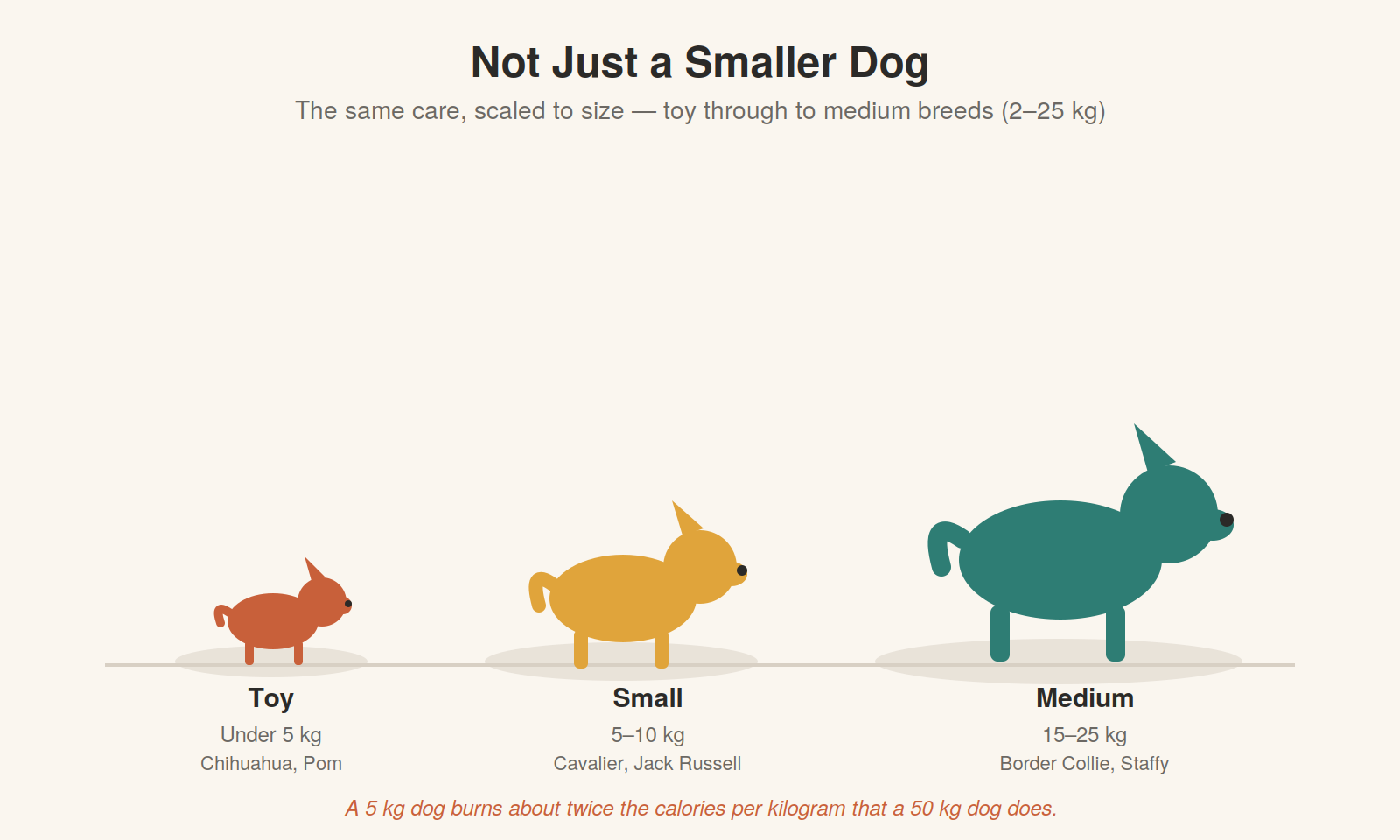
Throughout this course we’ll use the following size categories:
| Category | Adult Weight | Examples | Typical Lifespan |
|---|---|---|---|
| Toy | Under 5 kg | Chihuahua, Pomeranian, Toy Poodle, Yorkshire Terrier | 13–18 years |
| Small | 5–10 kg | Cavalier King Charles Spaniel, Jack Russell, Shih Tzu, Mini Schnauzer, Mini Dachshund | 12–16 years |
| Medium-small | 10–15 kg | Beagle, Cocker Spaniel, French Bulldog, Whippet | 11–15 years |
| Medium | 15–25 kg | Border Collie, Australian Cattle Dog, Staffordshire Bull Terrier, English Bulldog, Springer Spaniel | 10–14 years |
If you’re working with a dog over 25 kg, this course will still teach you a lot — but the calculations and some breed-specific recommendations will need adjustment. Above 30 kg you really want to be looking at large-breed nutrition specifically.
Seven ways small and mid-sized dogs differ
- Higher metabolic rate per kilogram. A 5 kg dog burns roughly twice as many calories per kilogram of bodyweight as a 50 kg dog. Smaller animals lose heat faster. This means small dogs need energy-dense food and tolerate missed meals poorly.
- Smaller stomach, faster transit. A toy breed’s stomach holds maybe 30–50 ml relaxed; a Labrador’s holds 1.5 litres. Small dogs can’t eat a day’s food in one sitting — meals must be energy-dense and ideally split.
- Dental crowding. Small dogs were bred down from larger ancestors but their teeth weren’t scaled down proportionally — crowded, overlapping teeth that trap plaque. Over 80% of dogs over age 3 show periodontal disease, small breeds worst.
- Hypoglycaemia risk in young toy dogs. Toy puppies under 1.5 kg have so little glycogen reserve that missing a single meal can drop blood sugar dangerously.
- Lower obesity threshold. Half a kilo of extra fat on a 5 kg dog is equivalent to 8 kg on a 70 kg human. Small dogs become obese on quantities that barely register on a Labrador.
- Longer lifespan. A toy poodle living to 16 has eaten nearly 12,000 adult meals. Small errors compound over more years.
- Faster maturation. Small dogs reach adult size at 9–12 months; large dogs take 18–24. The puppy-food phase is much shorter.
Breed-specific dietary flags
- Dalmatians and some Bulldogs: inherited purine metabolism issue — low-purine diets often recommended.
- Cavalier King Charles Spaniels: very high incidence of mitral valve disease — sodium control matters in middle age.
- West Highland White Terriers, Bichon Frise, Cocker Spaniels: higher rates of food sensitivity and atopic dermatitis.
- Miniature Schnauzers: prone to hyperlipidaemia and pancreatitis — dietary fat matters enormously.
- Bulldogs, French Bulldogs, Pugs: brachycephalic — benefit from kibble shapes for short jaws and slow-feeders.
- Dachshunds: obesity dramatically raises intervertebral disc disease risk — weight control is non-negotiable.
- Yorkshire Terriers: prone to liver shunts and pancreatitis; sensitive to high-fat diets.
- Jack Russells and high-drive working breeds: often underweight; need calorie-dense food in working seasons.
Key takeaways
- Small and mid-sized dogs aren’t scaled-down large dogs — their physiology demands a different feeding approach.
- The seven core differences all have practical feeding implications.
- Specific breeds carry specific dietary risks worth knowing.
Practical task: Choose a real or hypothetical small or mid-sized dog. Record its breed, age, current bodyweight, body condition score (1–9), and any known health conditions. You’ll refer back to this dog in every later lesson.